Common Sales Problems Small Businesses Face (and How Automation Fixes Them)
⚡ Quick Answer
Small businesses in India face critical sales leaks like missed WhatsApp inquiries, inconsistent follow-up (80% of sales happen after the 5th contact, but most give up after 1), and lack of lead prioritization. Automation fixes these by providing 24/7 instant WhatsApp responses, running 14-day multi-channel follow-up sequences automatically, and using lead scoring to surface the hottest prospects. Businesses typically see a 2-3x improvement in conversion rates by systematizing these repeatable tasks.
Problem 1: Leads Respond on WhatsApp but You Miss Them
India runs on WhatsApp. Your prospects do not fill long contact forms and wait 3 days for a callback. They message you on WhatsApp expecting an instant reply — and when they don't get one, they message your competitor.
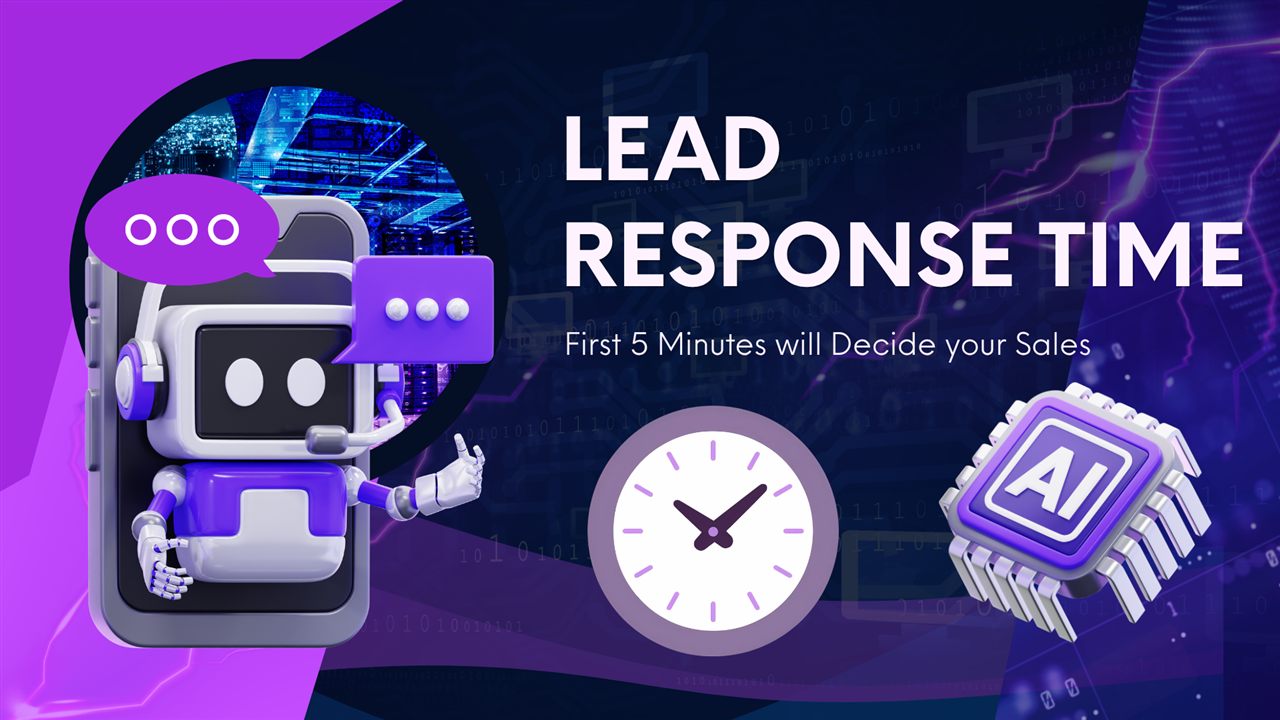
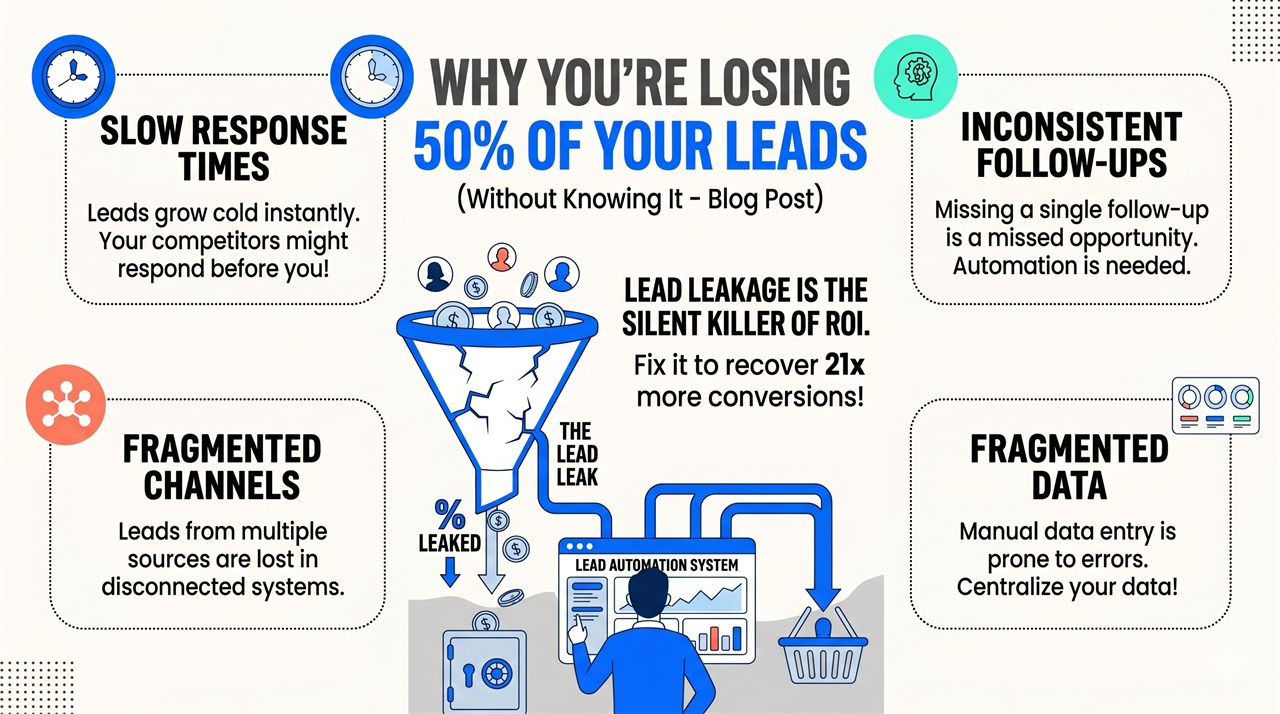
Here's the brutal math: a lead that doesn't get a response within 5 minutes is 21x less likely to convert, according to MIT research. But most small business owners are in meetings, with clients, or simply asleep when WhatsApp messages come in. By the time you respond — sometimes hours later — the lead is gone.
The problem compounds because WhatsApp doesn't integrate natively with most CRMs. So even if you respond, there's no tracking, no follow-up reminder, no history when the lead calls back a week later.
The Automation Fix
WhatsApp Business API automation sends an immediate acknowledgment the moment a message comes in — even at 2 AM. The auto-response isn't a generic "we'll get back to you." It's a personalized message that qualifies the lead by asking the right questions: What are you looking for? What's your budget? What's the best time to call?
While the lead is responding to your automated questions, the system logs everything to your CRM, creates a contact, and alerts your sales team with full context. Instead of cold-calling a number, your team calls back already knowing exactly what the lead wants. Conversion rates jump 30-50% just from this one change.
Problem 2: The Follow-Up Falls Apart After Day 1
You get a lead. You call. No answer. You try again. Still no answer. You send one WhatsApp. No reply. You give up. Meanwhile, that lead eventually buys — from someone who followed up eight times.
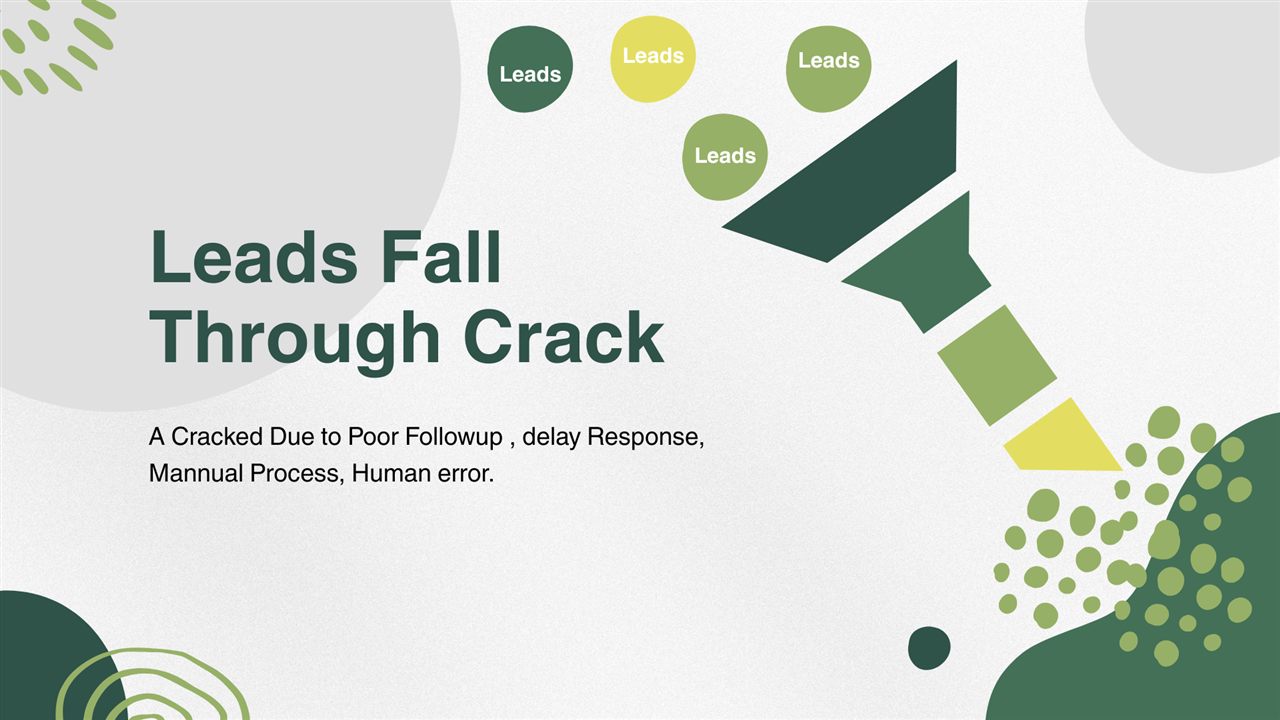
This is not a willpower problem. It is a systems problem. No human being — no matter how motivated — can consistently follow up with dozens of leads at varying stages across 10-14 days while also running a business. Something always falls through the cracks.
A survey by Salesforce found that 44% of salespeople give up after one follow-up attempt, and 80% of non-routine sales happen after the fifth contact. The math says most businesses are leaving 80% of their potential sales on the table.
The Automation Fix
Automated follow-up sequences run on a pre-set schedule regardless of how busy you are. A typical 14-day sequence might look like: instant WhatsApp (Day 0), personal call attempt (Day 1), email with case study (Day 2), WhatsApp check-in (Day 4), email with FAQ (Day 7), final call (Day 10), last-chance WhatsApp (Day 14).
Each message is sent automatically based on the lead's entry date — not your memory. The sequence pauses the moment someone replies or books a call. You never double-contact someone who already responded, and you never abandon someone who just needed a few more touches.
Problem 3: You Can't Tell Which Leads Are Hot and Which Are Time-Wasters
Not all leads are equal. Some are ready to buy today. Some are casually browsing. Some are your ideal customers; others will drain your energy and never close. But without a scoring system, you treat every lead the same — and your best salespeople waste hours on the wrong people.
This is especially painful for businesses that generate volume leads through Facebook ads or Google. You get 50 inquiries. Who do you call first? Without scoring, it's a guessing game — and you often end up calling the tire-kickers first because they're louder, while the serious buyer goes with someone else.
The Automation Fix
Lead scoring automatically ranks leads based on their behavior and profile. Actions like opening emails, clicking pricing links, visiting your website multiple times, and responding to WhatsApp messages all add points. Signals like a high budget, matching industry, or decision-maker title also add points.
Your CRM surfaces the highest-scoring leads at the top of your sales queue. Your team knows exactly who to call first — and they have context on why that lead scored high, which makes the conversation significantly more effective. Low-scoring leads stay in automated nurture sequences until they warm up enough to warrant human attention.
Problem 4: Your Sales Process Lives in Someone's Head
One of the most dangerous situations in a small business is having a star salesperson who holds all the knowledge. They know which pitch works for which type of customer. They know when to push and when to back off. They know the objections and the rebuttals. And when they leave? Your sales collapse overnight.
This is called key-person dependency — and it kills businesses. The process needs to be documented, systematized, and removed from individual memory. But most business owners never get around to documenting their sales process because they're too busy selling.
The Automation Fix
CRM pipelines force-document your sales process. Every lead moves through defined stages: New Inquiry → Contacted → Demo Scheduled → Proposal Sent → Negotiation → Closed Won/Lost. Each stage has automatic actions attached — emails sent, tasks created, notifications fired.
When you have this structure in place, any new team member can pick up a lead mid-pipeline and know exactly where it stands, what was said, and what the next action should be. Your best salesperson's playbook becomes the default process for everyone. The business becomes transferable and scalable.
Problem 5: You're Quoting Every Lead Manually
A prospect asks for a quote. You spend 20 minutes customizing a PDF, another 10 minutes finding their email address, and another 5 minutes writing the accompanying email. Then you wait. Then you follow up. Then you wait again. Then you forget. By the time you close the loop, it's been 2 weeks and the prospect has moved on.
For businesses that handle large volumes of inquiries — real estate agents, coaching institutes, event planners, software companies — manual quoting is a full-time job just by itself. It's one of the biggest hidden time-sinks in small business sales.
The Automation Fix
Proposal and quote automation generates customized PDF quotes and emails them automatically based on the lead's input. When someone fills a form choosing their service tier, project size, and timeline, the system generates a branded proposal, attaches it to an email, and sends it within seconds.
The proposal includes a digital signature option, an expiry date (creating urgency), and automatic follow-up reminders if not signed within 48 hours. Your conversion rate on proposals increases because follow-up never falls through the cracks and leads receive their quote while they're still hot.
Problem 6: After-Hours Leads Get Zero Response
A significant chunk of B2C lead activity in India happens between 9 PM and midnight. People browse products, compare services, and fill inquiry forms after dinner, after their kids go to sleep, after their own workday ends. They are in decision mode — and they are generating leads at exactly the time when your team is unavailable.
These after-hours leads have a dramatically shorter shelf life. If they don't hear from you by morning, they've already moved on. Research by InsideSales shows that leads generated on weekends or evenings convert at 20-30% lower rates than those handled immediately — simply because of the time lag.
The Automation Fix
Automation doesn't have business hours. Your after-hours leads receive an instant response, get a WhatsApp bot to answer basic questions, see available appointment slots, and can book a call for the next morning — all without any human involvement.
By the time your team arrives the next day, these leads have already been qualified, their information has been captured, and the slot is confirmed on your calendar. Instead of spending the first hour of the day chasing last night's cold leads, your team starts the day with warm, booked appointments.
Problem 7: You Have No Idea What's Actually Working
You're running Facebook ads, posting on Instagram, getting referrals, listing on Just Dial — but which source is actually generating revenue? Not just leads, but actual closed sales?
Most small businesses operate completely blind. They know their revenue. They don't know where it came from. So they can't double down on what works or cut what doesn't. They make marketing decisions based on gut feeling rather than data, and they inevitably waste money on channels that look active but convert nobody.
The Automation Fix
A proper CRM with UTM tracking and source attribution shows you exactly which channel, which campaign, and which ad generated each closed deal. The dashboard tells you that Facebook ads generated 40 leads but only 2 converted, while referrals generated 10 leads and 6 converted.
This data is available in real-time, not at the end of the quarter when it's too late to adjust. Your marketing budget automatically becomes smarter every month as you reallocate based on actual ROI rather than impressions and click-throughs.
Problem 8: Your Old Leads Are a Graveyard, Not a Pipeline
Open your CRM (or your Excel sheet, or your WhatsApp contacts) and look at the leads from 6 months ago. How many of them did you follow up with consistently? How many got a message last month? Last week?
Most businesses generate hundreds of leads, engage them for a week or two, and then completely forget about them. Those leads don't disappear — they just buy from someone else eventually. Studies show that 20-30% of leads that didn't convert immediately will convert within 6-12 months if you stay in touch. For most businesses, that's a goldmine sitting untouched.
The Automation Fix
Re-engagement sequences automatically reconnect with leads who went cold. A monthly newsletter, a "Happy Diwali" message with a seasonal offer, a "We have a new service you might love" update — these automated touches keep you top of mind without requiring daily manual effort.
When a cold lead suddenly engages (opens an email, clicks a link, replies to a WhatsApp), the system immediately flags them as active and triggers a personalized follow-up. Your dead pipeline becomes a living asset that generates sales without requiring any new lead generation spend.
Problem 9: Customer Onboarding Is Chaotic
You close the sale — and then the chaos begins. Documents need to be collected. Welcome messages need to be sent. Introductory calls need to be scheduled. Billing needs to be set up. The new customer is excited but confused, asking the same questions every new customer asks, and your team is scrambling to handle it all manually.
Poor onboarding is one of the biggest drivers of early customer churn. If a customer's first 30 days feel disorganized, they start doubting their purchase decision. Even if the product or service is great, a chaotic onboarding creates buyer's remorse and increases the chance they'll leave before they see real value.
The Automation Fix
Onboarding automation triggers the moment a deal is marked as closed. A welcome email sequence introduces the customer to your team, explains what happens next, and answers the top 5 questions new customers always ask. Documents are automatically requested with digital upload links. Calendar invitations for onboarding calls are sent with one-click confirmation.
The experience feels premium and organized — which increases customer confidence, reduces support load, and dramatically cuts churn in the first 60 days. You can onboard 10 new customers simultaneously with the same quality experience you'd give to one.
Problem 10: You're Trying to Compete on Price Because You Can't Show Value
When a prospect asks "why should I choose you over the competitor," and you don't have a compelling answer backed by data, the conversation shifts to price. You discount. The competitor discounts more. You discount further. Everybody loses margin, and the customer ends up going with the cheapest option anyway.
The businesses that win on value instead of price consistently are the ones that can demonstrate their expertise through content, show social proof through testimonials, and build trust before the sales conversation even starts.
The Automation Fix
Content automation nurtures leads with value before any sales pitch. Case studies, success stories, educational emails, industry reports — all sent automatically on a schedule that builds credibility over the entire sales cycle. By the time a prospect gets on a call with you, they've already seen proof that you deliver results.
Automated review and testimonial collection requests turn your happy customers into a visible trust machine. NPS surveys, Google review requests, video testimonial asks — all triggered automatically after key milestones. Your social proof accumulates without any active effort, making every future sales conversation easier.
Putting It All Together: The Integrated Fix
Here's the thing: these 10 problems don't exist in isolation. They're part of the same broken system. And the solution isn't 10 different tools — it's one integrated automation platform that addresses all of them simultaneously.
When you centralize your lead management, automate your follow-up sequences, implement lead scoring, and connect all your marketing channels in one place, something remarkable happens: your conversion rate doesn't improve by 10%. It often improves by 2-3x. That's because each fix compounds the others.
The Complete Automation Stack for Indian SMBs
- Lead capture: Facebook Lead Ads, WhatsApp Click-to-Chat, website forms — all feeding one CRM
- Instant response: WhatsApp automation with AI-powered qualification
- Follow-up sequences: 14-day multi-touch across WhatsApp, email, SMS
- Lead scoring: Automatic prioritization based on behavior and profile
- Pipeline management: Visual stages with automatic actions at each stage
- Analytics dashboard: Source attribution, conversion rates, team performance
- Re-engagement: Monthly automated touches for cold leads
- Onboarding: Triggered sequence on deal close
Real Example: How One Coaching Institute Fixed All 10 Problems
A coaching institute in Pune was generating 200+ leads per month from Facebook ads and Just Dial listings. They had 3 counselors and were converting about 8% of leads to enrolments. The owner felt like they were working constantly but not growing.
What Was Broken
Leads were coming in at all hours. Counselors were manually calling through a spreadsheet. Follow-up was inconsistent — whoever remembered to call, called. There was no tracking, no scoring, and no way to tell which ad was working. Old leads from 3 months ago were completely abandoned.
What Changed With Automation
Month 1: WhatsApp instant response reduced the first-response time from average 6 hours to under 2 minutes. Enrolment rate from same lead volume jumped from 8% to 11% — just from faster response.
Month 2: 14-day follow-up sequences launched. Counselors now only handled leads that had replied or requested a call. Cold calling dropped by 70%. Conversion from worked leads jumped to 18%.
Month 3: Lead scoring showed that leads from Google Search converted 4x better than Facebook leads. Budget shifted. Volume increased. Re-engagement campaign to 6-month-old leads generated 23 fresh enrolments with zero ad spend.
Month 6 results: Same team, same marketing budget, 2.4x revenue. The owner stopped working weekends.
Where to Start When Everything Feels Overwhelming
The temptation when you see a list of 10 problems is to try to fix all of them simultaneously. Don't. That's how automation projects fail.
Start with the highest-impact, lowest-effort fix first: instant lead response. Get your WhatsApp automation running so that every new lead gets a response within 2 minutes regardless of when they inquire. This single change typically produces a measurable ROI within the first month and builds momentum for everything else.
Then add follow-up sequences. Then integrate your lead sources into one CRM. Then add scoring. Then analytics. Each layer builds on the previous one, and within 3-4 months you have a complete system that runs largely on autopilot.
Not Sure Which Problem to Fix First?
Book a free 30-minute audit with our team. We'll look at your current sales process, identify your biggest leaks, and give you a priority list — no hard sell, no obligation.
Book Free AuditFrequently Asked Questions
The single biggest problem is inconsistent follow-up. Most small businesses follow up once or twice then give up — even though 80% of sales require 5 or more touchpoints. Automation solves this by running follow-up sequences automatically, with no human memory required.
Research shows salespeople spend only 34% of their time actually selling. The remaining 66% goes to data entry, scheduling, email writing, and administrative tasks — most of which can be automated, freeing your team to focus on conversations that actually close deals.
Absolutely. In fact, automation is most valuable for businesses without dedicated sales teams — it acts as a virtual salesperson that responds instantly, follows up consistently, and never calls in sick. Many small business owners use automation to handle the entire top-of-funnel process themselves.
Most businesses see measurable improvement in lead response rates within the first week. Conversion rate improvements typically show up in 4-8 weeks as automated sequences complete their full cycle. Full ROI realization usually happens within 3-6 months.
No — when done correctly, automation makes sales feel MORE personal. Messages are personalized with the lead's name, business type, and specific inquiry. Leads get faster, more relevant responses than they would from manual processes, and they feel attended to rather than ignored.
Entry-level automation can be implemented for ₹20,000-30,000 setup plus ₹5,000-8,000 per month. For most businesses generating 100+ leads per month, this investment pays for itself within the first month through improved conversions alone.
Modern automation platforms like GoHighLevel include CRM functionality built-in, so you don't need separate tools. The CRM and automation are tightly integrated, which is actually more effective than trying to connect separate tools.
Lead scoring automatically ranks your leads by their likelihood to convert. High-scoring leads (those who've visited your pricing page, opened multiple emails, or fit your ideal customer profile) appear at the top of your call queue. You always work the best leads first.
Unconverted leads enter a long-term nurture sequence — monthly emails, occasional WhatsApp touches, and seasonal offers keep you top of mind. When they're eventually ready to buy, your automated system detects the engagement and alerts your team. This typically adds 20-30% revenue recovery from leads most businesses had completely given up on.
No, B2B businesses benefit enormously from sales automation. The sequences are longer (B2B sales cycles are typically 2-6 weeks vs a few days for B2C), but the core problems — inconsistent follow-up, no scoring, manual quoting — are just as prevalent in B2B and automation fixes them the same way.